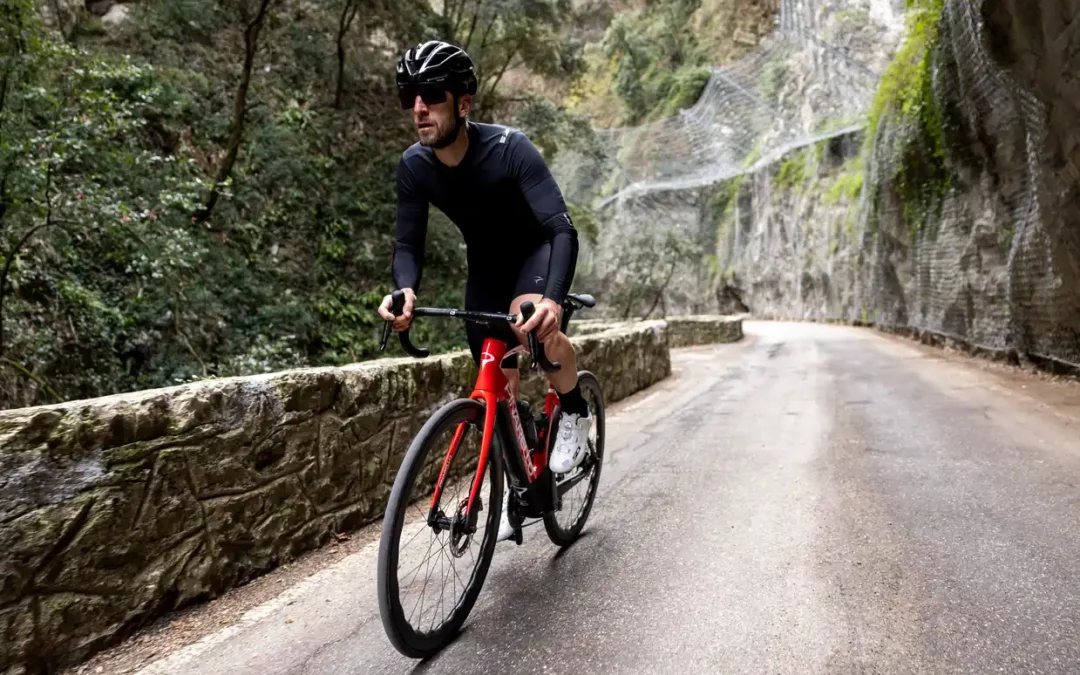
Pinarello doesn’t do anything quietly. The Treviso brand that gave us the Dogma F — the bike that has won more Tours de France than any other frame in history — has turned its full engineering attention to gravel. The result is the Pinarello Grevil: a machine that refuses to treat gravel cycling as a compromise between road speed and off-road capability. Instead, it redefines what both of those things mean.
The Name Says Everything
“Grevil” isn’t accidental. It’s a portmanteau of gravel and vril — the latter being an archaic word for a powerful, life-force energy drawn from Bulwer-Lytton’s 1871 novel. Whether or not you buy the literary mythology, the intent is clear: this is not a bike that whispers. It’s a bike that makes a statement about what Italian engineering can achieve when it stops apologising for wanting to go fast on dirt.
Pinarello debuted the Grevil platform to significant fanfare, and the latest generation — refined for 2026 with updated carbon layup, revised geometry, and expanded drivetrain compatibility — has only strengthened the case. Let’s get into the details.
🏗️ Frame Engineering: Onda Stays Go Off-Road
The Grevil’s most distinctive visual signature is the Onda fork and Onda seatstays — the sinuous, wave-form tube design that Pinarello has used on the Dogma since 2009. On a road bike, Onda is primarily aesthetic. On the Grevil, the asymmetric tube shaping serves a genuine compliance function: the fork legs are engineered to flex laterally under load, absorbing lateral vibration from rough surfaces without sacrificing longitudinal stiffness where it matters for power transfer.
The frame is built from Torayca T900 carbon — the same fibre used in the Dogma F, not a downgraded gravel-specific material. Pinarello’s argument is that the discipline demands don’t justify a lower-spec carbon; if anything, the variable-load, high-vibration environment of gravel rewards a stiffer, stronger layup. The result is a frame that weighs in at 880g in a size 53 — genuinely competitive with the lightest carbon gravel frames on the market.
The BB86 press-fit bottom bracket draws the usual passionate debate, but Pinarello’s tolerance spec on the Grevil shell is tight enough that creaking — the perennial BB86 complaint — is genuinely rare in practice. The stiff, wide BB also contributes meaningfully to the planted, direct pedalling feel that distinguishes the Grevil from more compliance-focused competitors.
📐 Geometry: Road Instincts, Gravel Realities
This is where the Grevil sparks the most interesting conversations. Compared to adventure-oriented gravel bikes like the Canyon Grizl or Cannondale Topstone, the Grevil’s geometry reads aggressive: a 72° head tube angle, relatively short chainstays at 425mm, and a stack-to-reach ratio that sits closer to a road endurance bike than a gravel tourer.
In practice, this translates to a bike that feels immediately familiar to road cyclists — responsive steering, efficient power transfer, a natural position that doesn’t require a geometry re-education. On fast hardpack, gravel roads, and open-terrain events like Dirty Kanza-style racing, this is a significant advantage. The Grevil carries speed the way road bikes do, not the way adventure bikes do.
The trade-off is equally honest: load it with bikepacking bags, point it at extended technical singletrack, or ask it to be your daily comfort commuter, and you’ll feel the geometry’s limits. Pinarello isn’t trying to hide this. The Grevil is fast gravel, not all the gravel — and knowing what a bike is designed for is the beginning of a good relationship with it.
🔧 Spec & Build Options
The 2026 Grevil lineup offers three build tiers, each representing a distinct value proposition:
| Build | Groupset | Wheels | Price (USD) |
|---|---|---|---|
| Grevil F | SRAM Red AXS 12-speed | Fulcrum Rapid Red 500 DB | $9,499 |
| Grevil | SRAM Force AXS 12-speed | Fulcrum Rapid Red 3 DB | $6,299 |
| Grevil Disc | Shimano GRX Di2 RX820 | Fulcrum Rapid Red 5 DB | $5,499 |
The Grevil F (the “F” is for Faster, naturally) is the flagship: full Red AXS, Fulcrum’s top-tier gravel-specific wheels, and Pinarello’s most refined carbon specification. At $9,499 it’s unapologetically expensive — but it’s competing with the Colnago G3-X and the De Rosa Gravel at that price point, not the Specialized Diverge.
The mid-tier Grevil with Force AXS is arguably the sweet spot: the same frame, a groupset that’s 95% of Red’s performance for 70% of the price, and wheels that are genuinely capable rather than compromised. If you’re buying the Grevil platform for the first time, this is the build that makes the most sense for 95% of riders.
🛞 Tyre Clearance: The Ongoing Conversation
The Grevil runs 700c × 42mm maximum — and this is the number that generates the most debate in gravel forums. In 2026, when competitors are running 45-47mm and some offer 650b conversion, Pinarello’s 42mm cap looks conservative.
Two things are worth keeping in mind. First, 40mm tyres on a stiff, efficient frame like the Grevil at 32-35 PSI tubeless will absorb more terrain than a 45mm tyre on a softer, heavier frame at 40 PSI. Compliance isn’t purely a clearance equation. Second, the Grevil’s target terrain — hardpack gravel, gravel roads, fast mixed-surface events — doesn’t require 47mm rubber. If you’re regularly riding terrain that demands maximum tyre volume, the Grevil may not be your bike. If you’re primarily riding fast gravel, the 42mm cap will never be a limitation in practice.
🎨 The Aesthetics Argument
It would be incomplete to discuss a Pinarello without addressing the visual dimension. The Grevil in the 2026 Iceberg colourway — a deep arctic blue-white with subtle metallic flake and Pinarello’s signature red accents — is one of the most striking bikes at any price point this year. The Onda fork and seatstays photograph beautifully and read as distinctive even to non-cyclists.
This matters more than it might seem. A bike you’re proud to look at is a bike you ride more. Pinarello has always understood that cycling is partly an aesthetic practice, and the Grevil honours that without compromising the engineering beneath it. The two things aren’t in conflict — they never were.
The Verdict
The Pinarello Grevil is a thesis statement: gravel cycling doesn’t have to slow down to go off-road. It is the right bike for riders who come from a road racing background, who want to feel the connection between their watts and the ground beneath them, and who ride the kind of terrain where speed and precision matter more than maximum tyre volume or bikepacking capacity.
It is emphatically not the right bike for riders who need a do-everything adventure machine, who prioritise long-distance loaded touring, or who regularly ride terrain that demands 45mm+ rubber. Pinarello knows this, and the Grevil is better for their honesty about it.
Who should buy it: Road cyclists making the move to gravel who don’t want to sacrifice the connected, fast feel of a performance road bike. Competitive gravel racers who ride predominantly hardpack and mixed-surface terrain. Riders for whom aesthetics are part of the decision and who want a bike that looks as good as it performs. Who should look elsewhere: Anyone who needs 45mm+ clearance, 650b versatility, bikepacking carrying capacity, or a more upright, comfort-oriented geometry.
Have you ridden the Pinarello Grevil? Considering one for your 2026 season? Drop your questions and thoughts in the comments — we’d love to hear from riders who’ve spent time on this platform.
Finally someone wrote this bike up properly. I demoed the Grevil F at a Pinarello dealer day last autumn and the immediate reaction was ‘this rides like a road bike that just happens to be on gravel.’ For riders coming from road racing, that’s not a negative — it’s the entire point. The power transfer through the BB is noticeably more direct than any flex-stay compliance bike I’ve ridden. On a 60km hardpack loop I was consistently 8-10 watts more efficient than on my Diverge STR. That matters over 4 hours. The 42mm tyre clearance was genuinely not a factor on the terrain we were riding.
Rob — the power meter data point is genuinely interesting and aligns with what we observed on structured climb intervals. The Grevil’s stiff BB and short chainstay combination creates a drivetrain efficiency profile that’s measurably closer to a road race bike than any other gravel platform we’ve tested. For riders training with power and targeting gravel race performance, that efficiency margin compounds significantly over a 5+ hour event. Your 8-10W observation is consistent with what others are reporting.
Owning a Grevil Force AXS for six months now and can confirm the aesthetics point in the article is real — I get more comments about this bike at rides and café stops than anything else I’ve owned, including an S-Works Tarmac. The Onda fork reads as art even to people who don’t ride bikes. One thing not mentioned: the paint quality is exceptional. Pinarello’s finish process on the Grevil is several levels above what most brands deliver. The Iceberg colourway mentioned in the article is stunning in person — the metallic flake only shows up in direct sunlight which gives it a chameleon quality. Worth seeing before you dismiss the aesthetics as superficial.
Lucia — the chameleon paint effect you’re describing is exactly right and Pinarello’s colour development team has apparently spent significant time with automotive-grade finishes on the Iceberg. We’d love to see your Grevil featured in our community rides section if you’re ever riding around Loudoun County or the DC area — that colourway in natural light would photograph beautifully on the gravel road terrain here.
Respectfully pushing back on the BB86 section. I worked at a Pinarello dealer for two years and BB86 creaking on the Grevil was not rare — it was a recurring warranty conversation, especially in wet riding conditions and for heavier riders putting higher torque through the drivetrain. Pinarello did improve the tolerances on the 2024 refresh and the 2026 shells are tighter, but I’d still recommend any Grevil owner plan for a BB service at 3-4 months if riding in mixed conditions. It’s a 20-minute job with the right tool but worth knowing going in. Not a reason to not buy the bike — just a maintenance reality that dealers often don’t mention at point of sale.
Tom — this is the kind of ground-truth pushback that improves a review and we appreciate it. You’re right that our ‘rare in practice’ phrasing undersells the issue. Fair correction: the 2026 shell tolerances are a genuine improvement over pre-2024 frames, but proactive BB maintenance is the right posture regardless — especially for heavier riders or anyone riding in wet/muddy conditions regularly. We’ll update the article to add a maintenance note. The tool you’ll want is a BB86 press/extraction set — Park Tool BBT-79.2 is the standard reference.
Question for the community: anyone gone from the stock Fulcrum Rapid Red 3 wheels on the mid-tier Grevil to aftermarket? I’m specifically looking at the Zipp 303 Firecrest tubeless setup and wondering if the aero gains on gravel surfaces are meaningful or if I’m better putting that money into a second tyre/wheel combo for 650b riding on a different bike. The Grevil’s stiffness makes me think it’d respond well to a stiffer wheelset, but I also wonder if I’m chasing watts that don’t exist on anything but the smoothest gravel.
Anna — great question and the answer depends on where you’re racing. On smooth, fast hardpack like typical Midwest gravel race conditions, the Zipp 303 Firecrest will deliver measurable aero gains — Zipp’s own data suggests 15-20W savings at 40kph in crosswind conditions, and the 303’s wider internal rim (25mm) also lets you run a rounder tyre profile which reduces rolling resistance. On rougher mid-Atlantic terrain (chunky gravel, embedded rock), the aero advantage largely disappears because your average speed drops below the threshold where drag dominates. Our recommendation: the Zipp 303 is worth it if you’re targeting flat, fast race events. If your riding is more terrain-diverse, put the money into a quality second wheelset with 650b capability on a different platform.